Tuesday, March 16, 2010

Fungi, worms and world view

We all have our own way of understanding the reality, although that does not mean that it is representative. Let's think, for example in the nemátodos. “The this pesao is already”, you will say many “speaking about filthy bugs”, good since yes. The nemátodos come to story because, except due to not very agreeable certain illnesses, most of the human beings are lived by us completely foreign to his existence. There are not even nice worms, like the poliquetos, or moderately interesting or disgusting, like the leeches, simply there are a worm limited to his elementary form, blancuzo, insipidly, tiny and completely obviable.

Readership, here a nemátodo, nemátodo, here a few friends

About 25.000 nemátodos species are known. They can seem great, but in the context of the long million and a half species of organisms (in 70 %, insects) that know each other do not seem great, scarcely a modest 1.6 %. Well, since the nemátodos are throughout and establish all kinds of symbiotic, often very narrow relations with a few certain organisms, it is thought that with all probability the importance of the nemátodos has been undervalued very much, probably in one or more magnitude orders. In fact, some specialists in invertebrates suspect that the nemátodos in fact might have a diversity comparable or superior to that of the arthropods. If to this we add to him that, although we do not know how many species exist in the whole world, but the whole world seems in agreement in which we know only one small part, we would be speaking about million species of nemátodos swarming round there. The world is a gusanal.

Let's think now about the fungi. The same you believe that you know more of fungi that of nemátodos, but it is not necessary to exaggerate either. Of course when one speaks to you about fungi think about this:

The best for the depression and for the omelettes

And also you will be wrong. The "mushrooms" are only the visible reproductive body that they produce a species fistful to liberate the spores, but the hifas are the real "body" of the mushroom: a network of microscopic filaments that spend the life without sorrow or glory mainly in the soil. Namely that although some of them produce mushrooms, the mushroom basically is a set of bland hifas that walk round there perreando without we paying the most minimal attention to them.

Hifas. Do not look any more, that is quite

Again speaking in numbers: it has described approximately 70.000 species of fungi (of some of them a few ADN sequences are known only obtained blindly). Although the estimations have ranged very much in the last years, it seems that very possibly they exist on one million and a half species of fungi, that is to say, so many species as that today it has described joining all the modern living beings. Again, a diversity inabarcable and anonymous, buried and in the dark or happening unnoticed for the humanity in an immense proportion.

This parallelism between the nemátodos and the fungi is not a coincidence. For the human being there are absolutely foreign creatures that do not say anything to us: they are small, scantly usable, underground, only we intergesticulate with a small proportion of his wealth, nothing representative and for our senses they are bored enormously and uniform … and nevertheless there can be one of the keystones of the biosphere. His world is absolutely different: without light and without sound, but with a wealth of chemical signs and of complex interactions that we do not prune ourselves not even to imagine.

Sharing so many things, it is no wonder that both lineages intergesticulate often. Perhaps the most surprising thing that happens that we know is that h moan fungi nematófagos, that is to say, fungi that they "eat" nemátodos.

The fungi nematófagos more acquaintances produce a few pitfalls with form of ring that close when the worm happens across him catching it and, possibly, digesting it thanks to a few special hifas that him suck to the worm up to the first mush.

A nemátodo, being caught by two pitfalls in ring of a mushroom.

Animation of the pitfall (constrictive version)

I have not found videos where is seen how the moment of the apprehension, but here we see a poor wretch nemátodo trying futilmente to escape of his mushroom captor.

These rings are the only one of six types of pitfalls that the fungi has developed during his evolution, including sticky hair of different forms, bonds, and real networks. According to this page there are known 160 species of fungi that they devour or parasitan to nemátodos. We know that there are a small part of a much major amount of to which our ignorance is encyclopedic. Extrapolating the information of the estimations we can calculate that, as minimum there are 4000 fungi species worms hunters, a number fifteen times higher than that of carnivorous mammals that exist.

Let's think finally about the images of documentary that we have of carnivorous mammals hunting: lions chasing to gazelles, wolves running behind fawns, the shift fox killing a partridge, the bear catching salmons in Alaska, and a length etc. Well, there is a universe at least fifteen times more diverse under our feet in that harmful fungi puts pitfalls to worms, chemical ambushes have a tendency, spectacular escapes and the life take place and the death they continue his course completely behind the back of us, that we are considered so important with our vertebrae, our eyes and our mortgages. And again, this is an only one smallest proportion of this parallel universe that vetoed to our comprehension, and all this in the dirt and the ground on that we tread. I do not know you but it comes to me very well to try to see the life like a worm. Curiously it does that it feels less important.


Monday, March 15, 2010

Two centimeters of grass

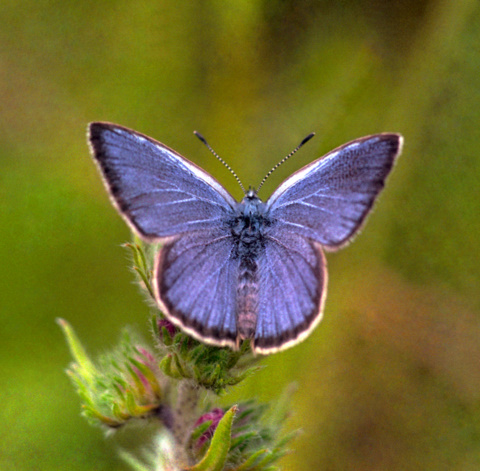
The protagonist of this entry is a small blue butterfly called Phengaris rebeli, (previously under the genre Maculinea) also acquaintance like “hormiguera of spots“. Lepidopterous tiny East is well-known for many decades on the part of the entomologists due to a few very curious peculiarities of his vital cycle. It belongs to the family of the licénidos, a few small butterflies and of delicate and discreet beauty that passions raise between certain photographers. Many licénidos larvae show some type of mutualism with the ants, being common that these defend in his nutritional insects plants theirs predators in exchange for molasses that exudan for a few glands of his cuticle. Nevertheless the species that occupies us became famous precisely for going a step further away and to complete the last phase of his metamorphosis inside an anthill. Apparently it was in 1956 when a British investigator saw by chance how a larva in last stadium of the Phengaris "was" "dropped" of the gentian that had fed it and how a working ant of the species Myrmica nausithous was taking it to his anthill.

The entomólgo in question had just spun what happened and announced the curious phenomenon: the larva had to suffer his last change as such in the anthill, being thus the chrysalis sure and protected under ground, emerging like adult in the suitable moment. The discovery of this singularity attracted the attention on this species of butterfly that was taking a time in frank regression and by the end of 50s it was practically extinguished in Great Britain. In 1960, like desperate measurement, the entomological shift society bought the area where there was living the last English population of Phengaris rebeli and the valló as last attempt of avoiding his disappearance. Let's make here a fully deserved comment about the well-intentioned intervention of these Englishmen. I do not know how many previous examples would be of protection measurements of a species of invertebrate, but I do not believe that they were great. Unfortunately, a few years later, this butterfly disappeared definitely of this shore of the English Channel. A decade later, the relative near Phengaris arion (=Maculinea arion), continued for the same way and became extinct in the whole country.

The history continues in the continental Europe, where the knowledge was extended on the biology of the hormiguera of spots. There ended up by being unraveled, for example, the biochemical trick that allows him to share cockpit with the jealous ants: a few porous glands secrete an attractive substance for the ants, while the called "tentacles" are in charge of producing the pheromone that identifies this larva as ant, avoiding to be devoured by his rent matrons. This does that the life of the larva depends completely on the correct functioning of these deceitful glands of the cuticle and turns the moment of the change into critic. Since you know, all the arthropods change his cuticle and this butterfly is not an exception. Newly gone out of the chrysalis, the new cuticle of the adult lacks the glands swindlers that we were mentioning and any ant that detects it will not hesitate to attack it. It is for it that the adult butterfly flees of the night anthill, while the ants are inactive, like an inverse thief: going out of the house with evening hours and secretiveness.

The new investigations met the same way on the possible cause of the extinction of the British population, since the biochemical relation of these butterflies was quite narrow with a species of ant (I remember: Myrmica nausithous), but not with others. Apparently, to the vallarse the area where the last butterflies population was living, the cattle stopped feeding in the area and the grassland did a few centimeters to itself higher. This was enough so that the average temperature of the soil was lowering of temperature a pair of grades, and this cooling of the soil was sufficient so that Myrmica nausithous was displaced by another species of very similar ant, M. scabridonis, not capable of being cheated by the glands of the larvae of the butterfly, which were turning out to be unable to complete his cycle.

Ironies of the life, the measurement driven to despair to protect the English Phengaris population with the whole good intention of the world was the one that provoked his extinction in the island. A marvelous example that demonstrates that the intricate relations between the living beings can be very surprising and that to realize works of conservation of fauna and flora it is not necessary to get tired of investigating and to study in depth the biology of the species, is not going to be that we end up by tying it up for things so dumb as two centimeters of grass.

The history of the butterflies hormigueras would give to speak very much: there are larvae that end up by being carnivorous and feed on eggs and larvae of the ants that lodge them; recently they have discovered that in addition to the chemical tricks, the ants larvae express also sonorous tricks to be identified like ants, and insurance that you find fascinating knowledge that there are wasps icneumónidas (these cabronas that put eggs in the larvae of other insects so that they are eating up them live inside showing the God's immense love) that they settle in the entry of the anthill and are capable of "hearing" if there is inside a butterfly larva hormiguera before risking to enter and put the "alien". Nevertheless I believe that it is worth finishing with good news. Last year was publishing in Science a few good results in the reintroduction of P. arion Swedes in the British islands: the populations were increasing thank you, between other things, to the correct diagnosis of the problem. Precisely there where the cattle was grazing again according to the traditional use of the area, the populations of the butterfly were prospering again demonstrating that the knowledge and the investigation are the key for the design of good strategies for the conservation of the threatened flora and fauna, and that once again the abandonment of the traditional uses of the area is a probable cause of the extinction of many species.

In north half of Spain there live four species of the genre Phengaris, including P. rebeli. The last one is considered to be according to the Red Book of the Invertebrates of Spain a vulnerable species. His principal threats are, as it was of waiting, the abandonment of the bovine and sheep pasture of his habitat and the proliferation of the tracks of ski along with some of his Aragonese populations.